Aug 072020
 

This is the draft as of August 7, 2020. Please add your comments at the bottom and we’ll update!

Eldercare has long been the stepchild of society’s pursuit of well-being – shunned by medical care and starved by social arrangements. A century ago, this did not matter much – people did not live so long, families were large and mostly on farms where taking in a relative was not so hard, and medical care did not have much to offer. The situation has changed, but the social arrangements have not kept up. COVID-19 has illuminated a number of the shortcomings. There will be a few short windows of opportunity to change things, but the advocates need to be ready with workable proposals. This blog aims to accumulate proposals that seem worthwhile for use by whoever wants to use them. Please add your comments and suggestions in the comments at the end!

Action Steps

  1. Everywhere that we see an opportunity, encourage broad public and leadership awareness of the high likelihood that each American will live with serious disability for a substantial period and that we are exceedingly poorly prepared to enable late life to be comfortable and meaningful. Write letters to editors, op-eds, and blogs. Call in to radio shows. Ask questions of candidates.
  2. Push to revise how we finance supportive care for elders. Allow pre-tax payment for long-term care insurance. Call for a new social insurance to cover “catastrophic” levels of costs from needing long periods of long-term care. Call for Medicare’s capitated plans (Medicare Advantage) to cover an understandable standard set of supportive services for defined situations.
  3. Generate data that will enable communities to understand how well their community is performing with regard to eldercare and that can monitor efforts to improve. We need visible data about the availability of home-delivered food, adapted housing and transportation, direct service workers, medical care at home, and the quality and reliability of personal care.
  4. Enable some local authority to monitor and manage eldercare on behalf of the community – could be the responsibility of the Area Agency on Aging, the public health office, a coalition of concerned entities, county government, or another approach – – but somehow, we need to create a locus of responsibility for improving performance.
  5. Strategize to reduce reliance on hospitals and nursing homes. They are essential in some circumstances, but many more people could be treated at home or in an outpatient setting, and many more people could go straight home from a hospital stay, IF the community had readily available and fully adequate supports for disabled people living in the community. So – advocate for more adequate funding for the Older Americans Act, which supports meals, care coordination, Area Agencies on Aging, etc. Advocate for more outreach to prevent abuse and neglect. Learn what is not available in your own community and push for that.
  6. Support family caregiving. Employers could seek to be flexible in leave, adjusted hours, and working from home. Respite care could be made available. Family caregivers could be paid in some circumstances and could get social security credits and Obamacare health insurance coverage.
  7. Improve the working conditions for direct care workers. Require a living wage, whether working in facilities or homes. Require conventional workers benefits. Ensure that they have the personal protective equipment and COVID-19 testing (or whatever else arises) that they need. Build career ladders with certifications and opportunities to advance.
  8. Push our organizations to be strong supports – AARP, Alzheimers Association, caregiver groups, professional organizations, provider organizations, political organizations, etc.
  9. Send in suggested questions for televised debates of candidates. Tweet to reporters.
  10. Express outrage over the forced isolation (solitary confinement!) of nursing home residents without even asking them about their tolerance for the risks, or enabling survivors of the infection to be more liberated from restrictions.
  11. Highlight the need for all elders to have comprehensive care planning, including advance care planning for medical care. Nursing homes and assisted living centers should have nearly 100% compliance and failing to undertake this work should be a cause for penalties.
  12. Study and respond to the evident disproportionate impact of COVID-19 on nursing home staff and residents who are African-American, Latinx, or immigrants.
  13. Encourage very limited liability protections for alleged shortcomings arising from COVID-19. The country should avoid a plague of lawsuits, but whatever protections are put in place should be limited in time and scope.

I’ve become quite fond of the hopefulness of this quotation – and a devotee of having good ideas “lying around.” So – let’s get behind them and push them to be politically inevitable!

“Only a crisis – actual or perceived – produces real change. When that crisis occurs, the actions that are taken depend on the ideas that are lying around. That, I believe, is our basic function: to develop alternatives to existing policies, to keep them alive and available until the politically impossible becomes the politically inevitable.” Milton Friedman

This is the draft as of August 7, 2020. Please add your comments at the bottom and we’ll update!

twitterrssyoutube
Mar 242020
 
Dr. Joanne Lynn Portrait. Photo credit Politico (used with permission)
Dr. Joanne Lynn

By Joanne Lynn

Within the next few weeks, the U.S. will experience a very large number of deaths from Covid-19. The evidence is now plain that these will mostly be persons over 60 years old, and many will be persons past 80 and persons already living with disabilities and illnesses associated with aging. Every one of us in that group should be making decisions about the desirability of hospitalization and ventilator support, yet no one is talking about making Covid-19 advance care plans. If a person chooses to turn down the hospital setting or the ICU care, whether for spiritual, pragmatic, or altruistic reasons, that person needs to be confident that symptom management for air hunger will be available. And our funeral homes, crematoria, and cemeteries need to be ready. Furthermore, separate from all those issues, the nation needs to be developing serologic testing for immunity, so we can tell who is immune and therefore able to return to work and visiting without the risk of infection from or spread of this virus.

Why are we not thinking ahead and preparing for these issues? This is the same problem we had in January, when it was already clear that this virus was so contagious that it would circle the globe. We are already way behind in dealing with today’s issues. Rather than being in the same position on near-future issues, we could deliberately get out ahead on these.

Every nursing home and assisted living facility should immediately move to get advance care plans for nearly all of their residents. These plans should be specific to the threat of Covid-19 in the context of the particular resident’s situation. Covid-19 in elderly and seriously ill persons mostly kills by respiratory failure, progressing over a few hours or days from a sensation of breathlessness to air hunger and suffocation. Only a minority of elderly persons who are put on ventilators survive to leave the hospital, and most have lost more functional ability from the deconditioning and struggle. Elders already living with eventually fatal illnesses and their families might make decisions to avoid all this and accept that a serious case of Covid-19 is very likely the end of their lives.

But someone has to ask them. Someone has to inform the elderly person or his or her surrogate decisionmakers and help them to understand their situation, and then to document their decisions, especially if they decide to go against the conventional pattern of going to the hospital or using a ventilator. These discussions are difficult, and the clinicians involved may find VitalTalk.com to be helpful. Families might resort to TheConversationProject.org to find the language needed. Leaders on television need to be encouraging these discussions and decisions.

Nursing home and assisted living residents are at particular risk because we really have no way to prevent outbreaks in facilities. This virus has about a 6-day incubation period in which the infected person has no symptoms but is already capable of spreading the virus. Someone is bound to bring the virus into some facilities unknowingly. With so many residents who cannot cooperate fully with isolation due to dementia or delirium, the virus is very likely to spread. So, a focus on advance care planning for residents of nursing homes and assisted living centers is urgent and is also able to be implemented. Still, half of our population of seriously ill or disabled elderly people are not in facilities; they are being cared for at home by family. So, families need to have the same conversations and make these decisions.

One painful aspect of these discussions is that hospitalization and ventilator use may become unavailable to these elderly or ill persons if our facilities become overwhelmed. We don’t need to dwell on this aspect, of course, but we do need to acknowledge that a decision to pursue fully aggressive medical treatment depends upon those elements continuing to be available.

In addition, a person whose care plan is to stay on site and not to use the hospital, or who has no option to get hospitalization, needs to be able to rely upon good symptom management for respiratory distress. This requires supplementing oxygen and providing morphine (or another opioid). Many nursing homes and assisted living centers will have had little experience with supporting people dying with respiratory failure as the cause. Hospice and palliative care practitioners will have the needed experience of titrating medication to relieve air hunger while leaving the possibilities open that the person might survive, but they need morphine and personal protective equipment. Even so, they will be stretched to serve suddenly large numbers of infectious people dying of respiratory failure at home and in facilities. These clinicians need to be in the list of high priority providers and their services need to be acknowledged and valued by leadership.

Morticians, funeral directors, crematoria, and cemeteries will need to be prepared for a surge of deaths, including many out of the hospital. Again, leaders should acknowledge and value these services and help to make arrangements for their workforce and supplies.

Finally, we will soon have a substantial number of people who have had their Covid-19 infection and recovered. Nearly all will have rid themselves of the virus within a month. But most will be uncertain as to whether they are immune because they never had a definitive diagnostic test, either because their illness was mild or because the testing was unavailable. Persons who are immune become very valuable to the public. They can return to work, they can visit sick people, they can provide care – indeed, they can be the vanguard of a return toward normal. But they need to know that they are immune, as do their employers, patients, and family members. This calls for development of and deployment of serologic testing, so we can know who is still susceptible and who is immune. We don’t yet know how long immunity will last, and the evidence in related viruses is for it waning over a year or two. But in the current year, these people are especially valuable since they cannot be infected and cannot spread the virus (with ordinary hygiene). We need leaders to be calling for development of this testing and making plans for deploying it – perhaps first to health care workers.

The nation is watching the experience in Italy with some horror – but it is over there and not here. We are not actually dealing with the likelihood that some aspects of their experience will be here, in at least some parts of the nation, in the next months. Let’s get over our reticence. We will have a great many deaths. Many will be in nursing homes and assisted living centers and most will be among people who are growing old. When a person is likely to die if he or she gets this disease, we should at least be clear as to what treatment the person wants. If the person is dying without ventilator support, he or she should have treatment to prevent feeling suffocation. Bodies should be able to be removed and buried or cremated promptly. And we should be ready to test for immunity within the next month.

These things are foreseeable. It’s time for leaders to talk and to put plans in place. Let’s get ahead of this pandemic on these issues.

twitterrssyoutube
Nov 132019
 
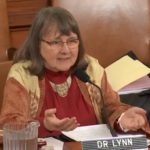
Dr. Lynn testifying before Congress.
Dr. Joanne Lynn, MD

The Ways & Means Committee of the U.S. House of Representatives heard testimony on “Caring for Aging Americans” on November 14. Dr. Joanne Lynn participated as an expert witness. A video of the hearing can be viewed at https://www.youtube.com/watch?v=20GgbnOMIn4.

Read Dr. Lynn’s comprehensive written testimony by clicking below.

Testimony_JLynn_to_WaysMeans_11-14-2019

twitterrssyoutube
Oct 222019
 
Logo of National Community Care Corps

By Sarah Slocum, Altarum Program to Improve Eldercare

We live in a country of neighborhoods. Our geographic neighborhoods often bond around a common ethnicity, a religion, similar economic status, or a group of occupations or employers. In large cities, perhaps it’s a school district. Across urban, suburban and rural areas, these factors that identify neighborhoods and communities are part of what helps us define where we live. This is particularly true of many frail elders and people with disabilities who often manage their daily needs with help from informal networks of individuals living nearby. A new initiative, funded by the federal Administration for Community Living (ACL), will create a formal network of volunteers ready to provide supports at the community level.

This brand-new effort, the Community Care Corps, will work with local organizations across the country to identify and develop tools that will be available to anyone wishing to start or strengthen a formal network of local volunteers. The project aims to develop the methods to support and enable these neighborly arrangements and create a network of volunteers who provide non-medical support to older and disabled people living in our communities — thereby enabling them to stay in their homes and remain connected to their neighborhoods. The Community Care Corps will identify best practices, standardize elements of high-performing volunteer programs in many different types of communities, and make starting and sustaining a volunteer support program much easier for any local organization to accomplish.

ACL has awarded St. Louis, Missouri-based Oasis Institute a five-year grant, with $3,800,578 in first-year funding ($19.7 million over 5 years) to stand up the Community Care Corps. In partnership with the Caregiver Action Network (CAN), the National Association of Area Agencies on Aging (n4a) and Altarum’s Program to Improve Eldercare, Oasis will help to develop and refine innovative models for volunteers to assist family caregivers, older adults and people with disabilities. Oasis will serve as the administrator of the project, awarding grants to communities nationwide. Community organizations will propose various creative ways of serving different populations, and a range of non-medical services, such as food, transportation, and other supports. The four lead organizations are eager to see what innovations they propose.

“This is a unique opportunity for Oasis to embrace a new role on the national stage as a grant maker for innovative caregiving projects,” said Paul Weiss, president of The Oasis Institute. “As a pioneer in healthy aging for more than 35 years, we recognize caregiving as a challenge that impacts families in ways that can limit quality of life tremendously. We are excited to be partnering with some of the most knowledgeable organizations in this sector to encourage creative approaches that can improve the lives of those who find themselves in the position of providing ongoing care for loved ones.”

Oasis will disseminate an RFP through multiple channels in late 2019, with anticipated grant announcements for the first year of funded pilot programs to be announced in spring 2020. Local funded programs will implement innovative approaches to recruit, train, and sustain volunteers who will provide neighborly help to disabled adults and their experiences will generate a toolkit of best practices for use nationwide.

“Volunteers have long played a key role in the reach and success of programs and services supported by the aging and disability networks,” said Edwin Walker, Deputy Assistant Secretary for Aging at the Administration for Community Living. “ACL is pleased to have this opportunity to further strengthen the important role of volunteers and looks forward to working with the Oasis Institute and its partners to achieve this goal.” An excellent article in the Kaiser Health News details this national initiative.

A local project is already underway in Livingston County, Michigan, where Livingston County Catholic Charities (LCCC) and Altarum are working to expand and update their volunteer services to elders and people with disabilities in their homes. LCCC was awarded a one year grant from the Michigan Health Endowment Fund to create a toolkit that will be available to any other organization that wants to set up a similar program to provide transportation, shopping, light housekeeping, companionship, and a number of other non-medical services to community members in need. LCCC is already well known for their volunteer services and this Care Corps project will enhance their ability to expand and provide more volunteer hours of service, as well as formalizing their volunteer recruitment, training, and retention strategies. The LCCC/Altarum project is one example of the type of community based effort Altarum will evaluate local efforts and will help identify best practices and ideas that are ripe for replication. The experience of people receiving support will be crucial in identifying the most effective strategies for delivering non-medical support and volunteers will be able to tell us a great deal about how well the program meets their needs. We expect many different and creative models arising from local projects and do not expect one model to fit all locales. As with the particular identity of a neighborhood, groups of volunteers and care recipients will have varying cultural and geographic characteristics and the Community Care Corps in their area will need to meet those needs.

The Community Care Corps is arriving at a time when a shortage of paid caregivers is putting a lot of pressure on community based care systems. Many service providers already report great difficulty filling jobs and retaining workers to provide care. Some worker advocates view volunteer efforts as competition, but the Community Care Corps partners see the roles volunteers will fill as part of a set of solutions that will support family caregivers and perform certain tasks that will lighten the load on paid caregivers. The same groups setting up the Community Care Corps are also highly interested in better wages, training, and career opportunities for direct care workers. Pursuing improvements in both the paid and unpaid caregivers’ situations will relieve some of the pressure on systems that will only intensify as our nation ages and more and more of us need care.

The Community Care Corps request for proposals will be available later this fall. What can you do? Make sure your local volunteer organizations know about this opportunity and encourage them to apply. Organizations that want to apply or would like more information should sign up for communications for an announcement by clicking here.

Once the first round of projects start, make sure elected officials know about this great innovation happening in their district and are invited to visit with volunteers and the organizations that support them. Speak up publicly to state and federal officials about the need for renewed social structures that promote neighborliness.

We can’t wait to get started!

twitterrssyoutube
Apr 302019
 
Portrait of Sarah Slocum
Sarah Slocum

By Sarah Slocum

Across the U.S., we see more and more reports about a shortage of well-trained staff who are committed to providing in-home and other long term supports and services. The pinch of the shortage is apparent in many communities where it’s difficult to execute in-home service plans, and residential providers struggle to stay adequately staffed. We all see this problem, but what are we doing about it?

An upcoming Michigan Department of Health and Human Services Long Term Care Study, including Workforce, is described in legislation http://www.legislature.mi.gov/documents/2017-2018/billconcurred/Senate/pdf/2018-SCB-0848.pdf Altarum and PHI, will lead the workforce component of the study that will formally quantify the current workforce and its future and make recommendations for how to meet the growing need for recruiting new caregivers. Some have asked, “Why study this again? We already know it’s a problem.” By now, everyone agrees – it has become urgent to develop consensus around an action plan and move rapidly to implement solutions. That is the mission of our study – to analyze what causes shortages; to agree on what can make entry-level caregiving jobs economically competitive and to create a plan that outlines continuing education, training, promotion, and mentoring practices that can transform currently dead-end jobs into rewarding and sought-after careers.

One issue to tackle is inadequate pay. When entry-level caregiving jobs compete with retailers, it is no surprise that those less complicated and less personally stressful retail positions are filled first. So raising pay levels in stepwise increments is one obvious answer. But beyond pay, we can already see a need for skills-based, value-focused career ladders that motivate direct care staff to stay and advance as they gain experience, take extra training, and acquire new competencies. Proposals like Advanced Care Aides, Mentor Caregivers, and Lead Direct Care Workers (see a summary at: https://phinational.org/service/advanced-roles/) are gaining momentum as avenues for professionalizing the field of direct care into one that encourages entry-level employees to be part of larger care teams – to take partial responsibility for good patient outcomes that are in turn linked to the possibility of greater recognition and reward.

In California, the California Future Health Workforce Commission (https://futurehealthworkforce.org/) has a plan to eliminate the state’s shortage of care workers by 2030. A state investment of $3 billion over the next 10 years will support changes in education, training, and recruitment of workers, and includes strategies to address care worker shortages in rural areas with particular focus on the needs of people of color. California chose to take a hard look at the worker shortage and created a bold, multi-faceted set of solutions that can serve as a template for action in other states.

In Michigan and elsewhere, issues we already know about include the need for employee supports in areas like benefits, paid time off, childcare, transportation support and better training. How do we actually address these issues? Again, studies are an important first step – but they must be structured to lead to follow-up and implementation. Altarum and PHI (see PHI’s 2018 report on workforce at https://phinational.org/resource/the-direct-care-workforce-year-in-review-2018/) will collaborate to quantify typical benefits packages for direct care workers today and estimate costs for improving them. We’ll also focus on the costs and possible return on investment for employers opting to offer ongoing training programs to help their staff accumulate new skills. And we will endeavor to examine whether a case can be made that a well-trained and well-supported workforce can lead to better patient outcomes.

As one care worker in Michigan recently said, “It is my mission to care for people, and I don’t quit even though there are many hardships. Just a little help – a little more support, can keep me and my co-workers providing care. But we need the help now!”

twitterrssyoutube
Nov 282018
 
Photo of Anne Montgomery and Aging Today Logo
Anne Montgomery

By Anne Montgomery

Originally published in AgingToday Volume xxxix: Number 6; November–December 2018 and is reposted here with permission.

In America and worldwide, the “age wave” has gathered in force—no more so than in Japan, where 27 percent of the population is already older than age 65, a number that will rise to 40 percent by 2060. Policymakers, spurred by widespread public interest in Gratton and Scott’s influential book, “The 100-Year Life” (London, UK: Bloomsbury Publishing, 2016), recently em¬braced this stark demographic fact.

International Efforts to Help Family Caregivers

Japan’s Prime Minister Shinzo Abe in 2017 convened a “Council for Designing 100-Year Life Soci¬ety,” directing members to expand “social security for people across all generations,” and institute free early childhood education and daycare and other “measures to secure the necessary caregiv¬ing personnel for reducing the number of people who leave employment to provide nursing care to zero.” The Council has met nine times, each time chaired by Abe.

A relatively new advocacy community that has sprung up to support family caregivers wel¬comed Abe’s efforts. Founded in 2010, the nonprofit organization Carers Japan has developed ini¬tiatives and objectives, notably enactment of a law to outline carers’ rights. The organization is helping and advising the Liberal Democratic Party, and others, to set up a parliamentary group for carers. Carers Japan also is sponsoring study groups for local politicians interested in amending city regulations to champion carers’ needs and priorities.

In the labor sector, advocates are pressing for added employment flexibility, to make it possible for carers to both work and support an ill or disabled loved one living at home. A recent change al¬lows Japanese workers supporting family members who need full-time medical care to take unpaid leave in up to three installments (https://www.igloballaw.com/japan-annual-update-expected-labour-law-changes-in-2017/). The maximum leave for years has been 93 days, and the legal entitlement belongs to the cared-for person, who has that amount of time to spend across his or her lifetime, which family members may use (https://www.oecd.org/els/soc/PF2_3_Additional_leave_entitlements_of_working_parents.pdf). Japanese companies are not required to pay employees during family care leave; if no wages are paid or only a partial wage below 80 percent of the worker’s base wage is paid, an employee can draw 40 percent to 80 percent of his or her base pay from unemployment insurance (https://www.oecd.org/els/health-systems/47884889.pdf).

These issues are becoming more prominent in many other countries. In the Middle East, Care¬givers Israel, launched in 2014, formed solid corporate relationships, and sponsors advocacy ini¬tiatives focused on paid and sick leave, new social security support for those caring for an ill family member and severance pay for people who must leave employment to care for a disabled family member.

In Asia, Carers Hong Kong formed to engage the government on pressing challenges—the need to invest in building a much larger workforce of paid aides, nurses and other personnel to support older adults and individuals with disabilities. In Europe, Carers Denmark organized in 2014 around a “Carers Charter,” which includes developing standardized caregiver training; creating caregiver consultants in all local municipalities to organize respite and daycare, and to conduct outreach to families and carers; and promulgating policies for political parties that speak to carers’ “rights and circumstances.”

Progress Being Made, but Challenges Remain

Making sustained gains that support family caregivers requires investing in more reliable communi¬ty services, and realizing a clearer understanding of family caregiver needs and wants. Underfunded community care and fragmented medical and community services across multiple providers and siloed settings could easily thwart significant progress. This is a particular challenge for America, where accountability for “whole person care” remains diffuse and elusive. Further reforms to promote employment flexibility—unpaid leave and teleworking—are needed, along with more focused pol¬icy discussions about the importance of paid leave to support family caregivers and people strug¬gling to cope with unexpected periods of illness and disability.

Among Organisation of Economic Co-operation and Development (OECD) nations, the U.K. has the richest history of advocacy and political work on behalf of carers. Founded in 1988, Carers UK is a continuation of earlier organizations, including the National Council for the Single Woman and Her Dependants, which secured the first tax benefit for carers in 1967, the Dependant Relative Tax Allowance. Following devolution 30 years later, Carers UK expanded into associated organiza¬tions—Carers Wales, Carers Scotland and Carers Northern Ireland.

Today, Carers UK champions rights to paid care leave and increased flexibility in the labor mar¬ket. Its 2013 report, The Case for Care Leave (https://www.carersuk.org/for-professionals/policy/policy-library/the-case-for-care-leave), notes that “with the public expenditure costs of carers feeling unable to continue to work estimated at £1.3 billion a year, it is crucial that we take steps to help carers in work. There is an opportunity to turn these losses into economic gains, with public finances seeing an estimated £1 billion in additional tax revenues if car¬ers can be supported back into the workplace.”

The report argued that “a statutory entitlement to care leave would help many carers to juggle their caring responsibilities with work in a sustainable and manageable way, making them more productive and less stressed, and saving businesses and the economy money in the long run.”

In the healthcare sector, policymakers are preparing to issue in November 2018 a new Long-Term Plan for England’s National Health Service (NHS), which will extend until 2028 (https://www.england.nhs.uk/long-term-plan/). Carers UK and other advocacy and political organizations are consulting with government officials to help shape the NHS plan with regard to carers.

New Policies on “Caregiver Strategies”

Though “caregiver strategies” are being developed in various countries, a 2016 OECD chart (https://www.oecd.org/els/soc/PF2_3_Additional_leave_entitlements_of_working_parents.pdf; p. 5-12) makes clear that countries are all over the map on how they structure care¬giver leave rights. Italy allows two years of paid leave over an employee’s lifetime, at 100 percent of earnings up to a ceiling, and Sweden provides paid leave at 80 percent of earnings up to a ceiling in episodes that can be up to 100 days. Cyprus allows only seven days of unpaid leave per year. The United States, under the Family Medical Leave Act, provides up to 12 weeks of unpaid leave for employees who have a year’s worth of service and work for medium-size and large firms.

Currently pending in the U.S. Congress is the Family and Medical Insurance Leave Act, which would provide paid leave for up to 60 days a year. Several states, including California, New Jersey, Hawaii, Rhode Island, New York and the District of Columbia, have already enacted state paid leave programs (http://www.nationalpartnership.org/research-library/work-family/coalition/family-act-faq.pdf).

In recent developments, the Progressive Policy Think Tank’s 2016 report, Caring for Our Carers: An International Perspective on Policy Developments in the UK (https://www.ippr.org/juncture/caring-for-our-carers), notes that “Australia’s and Canada’s Human Rights Commissions are leading the way in emphasising what a human rights approach to care and caring can bring, in starting to articulate a right to care, and in setting out the frameworks needed to make caring a real choice for carers and those needing sup-port.” The report also notes that “Japan, Germany, France, Belgium, Sweden and other countries are now using their long-term-care insurance schemes and tax systems to stimulate the develop¬ment of a wider range of care, household and personal services to ensure there is good support for care at home.” In America, there are plans to craft a federal blueprint for action following enact¬ment of the RAISE Family Caregivers Act in early 2018 (https://www.congress.gov/bill/115th-congress/house-bill/3759/actions).

In Europe today, there are an estimated 100 million caregivers, according to Carers UK. In Amer¬ica, though estimates vary, the number of family caregivers supporting older adults is reported to be about 44 million. In other surveys, four in 10 Americans report they are caregivers (https://archrespite.org/images/docs/Outside_Reports/PewResearch_FamilyCaregivers.pdf); in Canada, half of the population reports having provided support to a chronically ill or disabled loved one or friend at some point during their life (https://www150.statcan.gc.ca/n1/en/pub/89-652-x/89-652-x2013001-eng.pdf?st=MHJbYU_O). The reach of politically organized family caregivers seems primed to grow—and for families across the globe, that’s good news.

Anne Montgomery, M.S., is deputy director at Altarum Institute’s Program to Improve Eldercare, in Washington, D.C.

twitterrssyoutube
Oct 182018
 
Portrait of Dr. Joanne Lynn
Dr. Joanne Lynn, MD

by Joanne Lynn

Our aging society is a mountain to be moved – a large collective challenge we have to tackle together. Problem is, right now we’re using shovels when bulldozers would hardly do the job.

The mountain is reforming how eldercare is delivered and funded. We’ve allowed so many forces to converge over the years in a payment-driven, provider-centric framework, that we’ve managed to create a grim future for the last phase of aging. Most of us will have at least a couple years of self-care disability in the last years of life, no matter how healthy our life styles may become. While “healthy aging” is a terrific idea, it is one that eventually fails in most lives, simply because some form of frailty will still disable us, for a long time, and presage death.

Families are smaller, older, and more dispersed – there is often simply no one able to provide free care at home. Retirees have ever lower savings and insurance, overwhelmingly too little to pay for an expectable range of personal care. Medicaid is stretching state budgets and many more are set to spend down to eligibility. Communities have no entity actively monitoring and managing the performance of their unplanned and poorly coordinated eldercare arrangements. Serious illnesses and disability in old age is the dominant cause of family impoverishment and bankruptcy. Paying current per capita costs by raising taxes is not plausible by the mid-2030s [National Research Council. 2012. Aging and the Macroeconomy: Long-Term Implications of an Older Population. Washington, DC: The National Academies Press. https://doi.org/10.17226/13465] – we will find ourselves balancing crippling the economy with abandoning dependent patients. Being able to support an expansion of public services and supports to accommodate more elders in need depends upon a thriving economy, and that depends upon highly productive young adults. Yet we now have half of children born into poverty and we tolerate high rates of young adults being unprepared for productive work.

Many issues compete for our attention. Why bother with dealing with old people? Two pragmatic reasons: old people and their children vote, a fact that makes it unlikely that elder care issues will be abandoned; and all of us will eventually join that cohort, a fact that makes it everyone’s issue. Furthermore, we really are part of a community, and we really won’t be able to ignore a retired school teacher’s homelessness, the gnawing hunger and painful isolation of a former jazz musician. Our better natures will require making basic needs available on a reliable basis.

In 2016, our team at Altarum worked with other national partners to push for caregiver planks in state and national party platforms — 11 states included a plank as well as having the issues show up for the first time in both Democratic and Republican national platforms. [Scribner, B. et al. (2017). Creating A Nationwide Nonpartisan Initiative for Family Caregivers in Political Party Platforms. J Am Geriatr Soc, 65: 1126-1131. doi:10.1111/jgs.14814] A key finding of voter polling work in this project was that voters of all political persuasions are energized and passionate equally about the needs of caregivers and supports that ought to be made available to families.

But how? The costs look to be overwhelming. The effects upon the economy and the opportunities for younger persons look to be disastrous. It is so much easier to duck and run – answer to the immediate issue but make no fundamental changes. There’s a better way.
Our arrangements for medical care assumed that people are mostly healthy and on their own, and from time to time they need medical care to return them to health. In frail old age, the question is not mostly to “fix it” but to “live well with it.” In this setting, continuity, care planning, and caregiver support matter – three elements that are mostly missing in our current health care. We need to dramatically reorganize health care to require these elements as essential in elder care.

What happens to support frail elders depends critically upon the arrangements for support in their geographic community. Is disability-adapted housing available and affordable? Can you get appealing and affordable home-delivered food? Is there an adequate workforce skilled in handling personal care at home, even for persons with dementia and persons who are difficult to serve? Do the dominant employers provide flexibility for family and volunteer caregivers? Are there volunteers organized to fill in most “instrumental activities of daily living,” such as minor home repairs and delivering food? Perhaps most important, is there an entity with the responsibility to address these issues – to monitor performance in that community and take steps to improve it?

With many communities doing this, communities would be able to benchmark performance and manage the arrangements in their community. Lots of independent businesses would still thrive, but collective action would also be possible and practices that distort service availability or quality could be constrained. Altarum developed a Financial Forecasting Tool [https://medicaring.org/2018/07/24/mcforecasting/] that can help communities understand the resources they already have — medical and health services, social services, community volunteer organizations, and others — and quantify the possible savings a reformed system of eldercare can produce. There is a lot of money being spent in the period when elderly persons live with serious disabilities, but it is not being used in planned, efficient, person-centered ways.

This is a more fundamental reform than just moving medical care to the home or providing coordinated post-hospital care, or whatever combination of currently “evidence-based” improvements you prefer. This is making some part of elder care into a public concern, managed at the community level. It is not just for dual-eligible elders, it is not just for persons who run up high bills, and it is not just for persons with particular diagnoses. This reform is for us all. We’ve called it MediCaring Communities. [https://medicaring.org/book-online/]

We must work on financing and service delivery at the same time. If we started now to build private savings for long-term care (through savings accounts or insurance), we’d have capital to stimulate the economy as well as less demand for public funding in fifteen years. Having a federal back-stop on long term care costs would create a vibrant marketplace for long-term care insurance. Professionalizing assistance with personal and supportive care would create better paying jobs in the care sector and these professional caregivers would be able to build a new middle class around eldercare professions, thus boosting, rather than draining, local tax bases. Planning for the whole populace also requires substantial reinvestment in ensuring that our children come into adulthood as highly productive citizens.

This is our opportunity time. If we buckle down and enable substantial innovation in some counties and cities, we’d learn what’s possible and other counties and cities would follow suit. We urgently need an era of profound and far-reaching innovation and learning. What can you do make it possible to overthrow the status quo? Be in touch with one another and with us – let’s dramatically increase the pace of improvement and build an elder care system that is highly reliable and efficient and build it in time to accommodate the rising numbers of disabled and frail elders.

twitterrssyoutube
Sep 262017
 
Red Image of America Cares Chartbook

The America CARES Forum was held on November 14, 2016, a week after the national election. Sponsored by Altarum with Caring Across Generations, the forum featured national polling data from Lake Research Partners and The Tarrance Group. The polling showed strong support for major policy advances for both family caregivers and direct care workers, as demonstrated in the data from the Chartbook for America CARES [click to download the PowerPoint file]. Voters of all stripes ranked caregiving as a major concern and all endorsed substantial policies to make caregiving more possible and less burdensome.

Overall, the number of older adults over the age of 65 will nearly double by 2050 and the 80+ population is projected to increase 79% from 2010 to 2030 and 44% from between 2030 and 2040. These changes, coupled with falling birthrates, will create a care gap, with less than 3 people of working age (potential caregivers) for each older adult in need — compared with a 7:1 ratio in 2010. Meanwhile, labor force participation among women ages 25 to 64, who currently make up 73% of the home care workforce, will increase by only 2 million in the next decade, compared to 6.3 million in the previous decade.

Caregiving issues will shape the politics and policies of the coming decades.

twitterrssyoutube
May 242017
 
Poster showing elder and caregiver

The Center for Elder Care and Advanced Illness is proud to support CARE, a 65-minute documentary about the increasing importance of caregiving in our aging society; the passionate caregivers who often earn poverty wages; and the families who struggle to afford the care they desperately need. We hope you will join the CARE team in support of the work we all do to move towards a more just, and equitable care system for all!

How can you help?

Bring CARE to your church, community organization, campus, or workplace. Local screenings help to spread awareness of eldercare issues, create fundraising opportunities for local care networks, and empower and educate the public about efforts to improve our care system to better support both elders and caregivers. To learn more, reach out to the film team by visiting www.caredocumentary.com or contacting Denae Peters at [email protected].

twitterrssyoutube
Jan 102017
 

By Anne Montgomery and Josie Kalipeni, Caring Across Generations

The Public Attitude on Caregiving in 2016: The America CARES Forum

On November 14, 2016, six days after the election, Altarum Institute’s Center for Elder Care and Advanced Illness and Caring Across Generations (CAG) hosted a national forum: America CARES. As participants, we talked broadly about what voters signaled they wanted; what implications the election may have for our work looking ahead; and what our primary objectives are as our country hurtles into the longevity era.

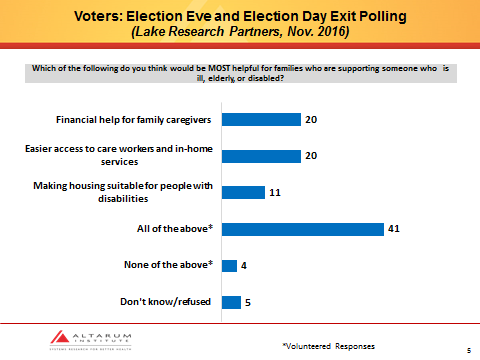
As the morning progressed, it became clear that our core, collective work of moving initiatives forward to help family caregivers and care workers who provide assistance in the home, is precisely in line with what all of us want—both for ourselves and our aging family members. We found evidence of this when we looked at exit polling data from voters who were interviewed on election eve and election day; when we reviewed what advocates and experts said was important; when we took into account recommendations from the National Academy of Sciences, Engineering, and Medicine’s recent report on caregiving; and when we examined our own advocacy.

Responses to poll from Lake Research Partners on policies to help people who are ill, elderly, or disabled.

Polling Data from Lake Research Partners on policies to help people who are ill, elderly, or disabled.

We talked about how our current health care system typically treats only immediate, pressing health care issues, while ignoring those for which ongoing management is the best solution. And, we discussed what we can do to move initiatives forward that will improve the economic security of tens of millions of caregiving Americans in communities across the country, while also boosting the fortunes of the four million workers who care professionally.

“As a nation we really are at a crossroads right now,” noted Sarita Gupta of Caring Across Generations. “We can stay with the status quo patchwork system and let the next economic crisis take place in our homes; or we can take advantage of this tremendous opportunity to build the care infrastructure we need, and support the realities of 21st century families [by] meeting the country’s soaring needs for home-based care and more affordable childcare.” That involves, she added, “making major investments in our ‘people’ infrastructure.”

“On a fundamental level what we have in common is that we want to create a much stronger care economy,” Anne Montgomery of Altarum said. “There is no doubt that we have it within our power to create change that is wanted and needed, and to take that forward. Our system is designed to make that possible, and we know that money does not produce the best ideas. Collective work does.”

To push such an agenda forward, America CARES forum participants worked to distill the day’s deliberations and conversations around a set of principles:

  • Providing better financial assistance to family caregivers—in the form of tax credits, direct payments, flexible paid family leave that includes both child care and elder care, and substantially improved access to coverage options that incorporate high-quality, affordable long-term care services;
  • Providing improved skills training and advancement opportunities for care workers, along with access to retirement savings and other standard employment benefits; and
  • Establishing creative new ways of prioritizing and paying for adapted housing that enables people with disabilities and other types of limitations to live as independently as possible.

Along the way we hope to be able to widen the base of support for tens of millions of Americans who are caring today, as well as the roughly three-quarters of us who—if we live long enough—will need support. The truth is that very few people can pull this off entirely by themselves—either the caregiving or the arranging of and paying for care. The odds of success are much better if we work together in complementary and interdependent ways to organize caring systems in our communities. Josephine Kalipeni, director of policy at Caring Across Generations said, “Building support, the ‘caring majority’ if you will, is critical to moving forward what we want to see. The voice of the caring majority can demand improving and expanding existing programs, creating new needed programs, and holding elected officials accountable for what we all really need—an affordable, accessible system that works for everyone.”

As we grow older, we want our health care system to provide the “right care at the right time guaranteeing an organized continuum of services that are adjusted for each person’s unique needs, goals and preferences. This is the essence of person and family-centered care, and there is already considerable evidence that it is both attainable and cost-effective. The question we have to ask ourselves is, if we had the opportunity to do it all over, would we rebuild the system of acute care interventions that was the blueprint in the 1960’s, or would we build something different that works for the 21st century family?

At the November 14 forum, Gupta noted that “the more opportunities we have to come together to share updates on our work and look for the opportunities to cross-collaborate, the stronger our organizing, and the stronger the care agenda will be.” Affirming this, CAG political director Kevin Simowitz emphasized that “we have to talk about care as an economic issue and not solely as a moral imperative.”

At a national level, the Trump Administration and the 115th Congress will be required to address hundreds of challenges every day. Competition for the attention of policymakers will be fierce, and multiple proposals representing a wide range of interests will be aggressively pushed and lobbied. In the public sector, the fate of national health care programs that serve frail elders and people with disabilities is highly uncertain—notably in the case of Medicaid, which could be transformed into a series of divergent state programs if funding caps are approved and longstanding quality and accountability rules are erased. But there is no doubt that amplifying the voices and advocating on behalf of more than 90 million Americans who voluntarily step up to support someone who needs care is a high honor. Our New Year’s prediction for 2017 is that increasingly, policymakers will recognize that supporting family caregivers and care workers is simply the right thing to do. But we know recognizing this isn’t enough. We need action.

Toward that end, we hope you will join our efforts as we strive to help build an even stronger movement dedicated to improving how we care for each other in old age and during times of illness and disability.

Are you a member of the caring majority who is receiving or providing care? Add your voice to this growing movement. Share your story with us. Send us materials to post at the link above. We’ll also be out on January 21 bringing a message of inclusiveness to the Women’s March on Washington from family caregivers and direct care workers who cannot be there. Please email [email protected] if you would like to march with us, and we will send you the details.

twitterrssyoutube