Dec 062016
 

By CECAI and Caring Across Generations Staff

Caring for others has become the defining issue of our time, and grows increasingly salient in political campaigns with each passing day. This emerged as the defining theme of a November 14th forum, “America CARES,” which was headlined by Altarum Institute’s Center for Elder Care and Advanced Illness and Caring Across Generations.

Coming less than one week after the national election, more than 200 caregivers, researchers, analysts, and advocates gathered online and in person in Washington, D.C., to discuss voter preferences, share information about what stakeholders and advocates are prioritizing, and focus on what can be moved forward through deliberate collaborative work.
Much attention was paid to what voters think, as measured in bipartisan national polling conducted on election eve and election day by Lake Research Partners (LRP):
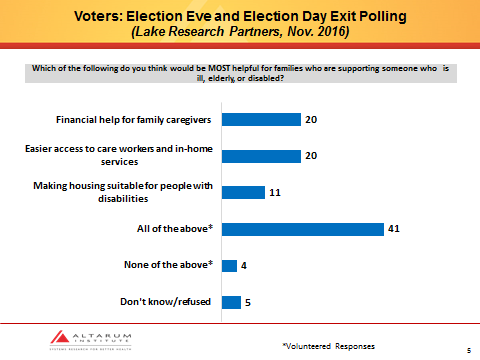
Responses to poll from Lake Research Partners on policies to help people who are ill, elderly, or disabled.

As both LRP principal Celinda Lake, a Democratic pollster, and Brian Nienaber of The Tarrance Group, a GOP pollster emphasized, the most striking finding is that both Trump and Clinton voters overwhelmingly chose “all of the above.”

“When you look across these demographics, this [caregiving] issue is of major salience to groups in both coalitions,” Lake said. Women care particularly intensely about this issue, [and] so do seniors.” She continued: “This issue needs to be embedded in a broader economic frame. We are talking about it in too minor a way.” Nienaber added: “When you get people volunteering ‘all of the above’ that is huge…[It] is one indicator that [voters] grasp the depth of the problem, and I think too an indicator that they are just not sort of fully versed in what the most appropriate or easiest bite-sized solution is.”

For this reason, Lake suggested that messaging on this issue should always be “1/3 problem, 2/3 solution.” As Josie Kalipeni of Caring Across put it, “[It] creates an umbrella to say that we need a system that works for all…and to have a unified message while bringing expertise of what [each organization] is advocating for to the table.” Moreover, a third of respondents favored all three options presented for expanding the number of direct care workers: increasing wages to $15 per hour, benefits including paid time off and retirement savings, and opportunities for skills training and career advancement.

What voters say they want are the things we don’t have in place in our health care system today—except for in-home services—and these are not reliably available or affordable for many people. The system that we have in place today, in other words, is effectively not the one we need in a rapidly aging society.

But there is also good news: Kevin Simowitz of Caring Across Generations pointed out, “caregiving entered the presidential campaigns this year in a way we haven’t seen it enter before,” with care appearing on both the Republican and Democratic national party platforms (for more on how this happened, see the Family Caregiver Platform Project). Multiple speakers reiterated the need to make an economic case for care policy in combination with stories about the people impacted. As Ben Chin of the Maine People’s Alliance pointed out, “the public is with us on tax fairness right now. “Maine People’s Alliance managed to get a measure on the ballot in 2016 that provided 3% surcharge on income over $200,000 to fund education. “In districts where many voted for a right wing populist, they did vote for this,” he said. This dynamic can be used again, he argued, noting that polling from Caring Across Generations has found broad bipartisan support for universal family care funded by tax increases on those making more than $100,000.

In a new long-term care white paper, Caring Across Generations recommends the creation of a state level public long-term services and supports benefit that is accessible to all who need it regardless of income. “We continue to see tremendous opportunities in the states, and we believe that states can and must take intermediate steps to expand access to affordable and accessible long-term care until federal improvements are made,” said Sarita Gupta, co-director of Caring Across Generations. “State-based programs can address the unique care problems faced within each individual state, yield invaluable insights into what works and what does not, and build momentum for an eventual federal solution.”

The fact that people want much more integrated and well-coordinated care was also clearly reflected in responses to an online survey of registered participants fielded by Altarum. Participants were asked to rate their support for a number of policies. Of the 5 most that were most strongly supported, 4 out of 5 related to coordination of support: 1) ensuring availability of adapted housing; 2) development of a comprehensive repository of social resources and the community level; 3) caregiver assessment in Medicaid, Medicare, and the VA; 4) flexible workplace policies; and 5) expansion of integrated, community-based programs such as the Program of All-Inclusive Care for the Elderly (PACE).

To establish a system that is effective, we need to adapt, re-engineer and redesign to include health-related social services and supports in the array of services that are available on a reliable basis. Roughly 70% of us will spend several years—and for some it will be many years—living with both multiple chronic conditions and functional limitations.

We know that 34 million family caregivers and 2.2 million care workers provide care to older adults and people with disabilities in the community. Both groups struggle to maintain financial stability, to coordinate care, to maintain physical and mental well-being, and to balance their work and family responsibilities, and are becoming increasingly active as political groups. One of the goals of this event was to unite family caregivers and care workers with a common care agenda.

The most prominent theme of the forum was that care is a unifying issue that provides a blueprint for tailoring positive advocacy in a more populist era. Again and again, speakers emphasized the universality of the need for care. Noting that there will be 47 mayoral elections and 36 gubernatorial elections in 2018, Lake suggested that advocates, analysts, stakeholders and their allies have a solid opportunity to make caregiving actionable at the ballot box. Participants also highlighted the Caregiver Advise, Record, Enable (CARE) Act as evidence of what can be accomplished at the state level, in addition to the ways in which care transcends partisan politics. This bill would require that hospitals record the name of the caregiver in the medical record, inform them if the loved one is transferred, and provide instructions and training on tasks that the caregiver will be expected to perform at home. The traditionally red state of Oklahoma, John Schall of Caregiver Action Network noted, was the first state to pass the CARE Act.

Voters have provided a green light to move forward—at the national level, the state level, and the local level. And we look forward to working with all of you to do that. Together we have a clear opportunity to shape policy and to ensure that those who care, whether as unpaid family members or as workers, live in dignity and have the tools they need to support those for whom they care.

twitterrssyoutube
Jun 202016
 

MediCaring Communities: Getting What We Want and Need in Frail Old Age at an Affordable Cost
Published June, 2016
194 pages, 6″ x 9″ (15.24 x 22.86 cm)

ISBN-10: 1481266918

List Price $9.95 at Amazon.com

Americans want a long life and most of us will get to live into our 80’s and beyond, but we have not squarely faced the challenges of living well in the last years of long lives. This book lays out a thoroughly pragmatic way to organize service delivery and financing so that Americans could count on living comfortably and meaningfully through the period of disability and illness that most will experience in the last years of life – all at a cost that families and taxpayers can sustain. MediCaring Communities offers to customize care around the priorities of elders and their families and to manage the local care system so it is reliable and efficient.

MediCaring Communities book cover

MediCaring Communities book (click cover to view on Amazon.com)

Three out of four of us will need long-term care. The period of needing someone’s help every day now lasts more than two years, on average. Most of us will not have saved enough to get through this part of life without financial help from family or government – indeed, we’ll spend almost half of our total lifetime healthcare expenditures in this last part of life, mostly on personal care that is not covered by Medicare. We have not yet required housing to be modified for living with disabilities or secured a ready supply of home-delivered food, and we certainly have not required medical care to focus on the patient and family priorities in order to enable the last years to be meaningful and comfortable. Family caregiving will be a crisis as families become smaller, more dispersed, older, and facing inadequate retirement income for the younger generation.

MediCaring Communities improve care by building care plans around the health needs and living situation of the elderly person and family, and especially from respecting their choices about priorities. The improvements in service delivery arise from integrating supportive services at home with customized medical care and installing local monitoring and management. The improvements in finance arise from harvesting savings from the current overuse of medical tests and treatments in this part of life. These come together in MediCaring Communities.

Strong evidence supports each component, but the real strength is in the combination, where savings support critical community-based services, communities build the necessary environment, and elders and their families craft their course with the help of interdisciplinary teams. This book lays it out, using expansion of PACE (The Program of All-Inclusive Care of the Elderly) as the test case. The book provides a strong and complete guide to serious reform, and just in time for the aging of the Boomers which will escalate the needs dramatically during the 2030’s. Now is the time to act.

You can read extracts online.

Advance Praise for MediCaring Communities

“For decades, Joanne Lynn’s has been the clearest, strongest, most soulful voice in America for modernizing the ways in which we care for frail elders. This essential book is her masterpiece. It offers a magisterial, evidence-based vision of that new care, and an entirely plausible pathway for reaching it. Facing a tsunami of aging, our nation simply cannot afford to ignore this counsel.”
—Donald M. Berwick, MD, President Emeritus and Senior Fellow, Institute for Healthcare Improvement, and former Administrator, Centers for Medicare & Medicaid Services.

“MediCaring Communities integrates good geriatrics and long-term services and supports, and building upon an expanded PACE program can be a tangible start. We should try this!”
—Jennie Chin Hansen, Lead in Developing PACE; Past President, AARP; and Past CEO of On Lok Senior Health Services and the American Geriatrics Society.

About Joanne Lynn

Joanne Lynn, MD, MA (Philosophy and Social Policy), MS (Quantitative Clinical Sciences), is Director of Altarum Institute’s Center for Elder Care and Advanced Illness. Dr. Lynn has served thousands of persons in their last years of life in home care, office practice, hospice care, and nursing homes. She was one of the first hospice physicians in the United States. Dr. Lynn has been a tenured professor at Dartmouth and George Washington University, a quality measurement expert on the staff at the Centers for Medicare & Medicaid Services, the Bureau Chief for Cancer and Chronic Disease in the public health office for Washington (DC), a senior researcher at RAND, and on the Institute for Healthcare Improvement’s quality improvement faculty. She is a member of the National Academy of Medicine, a Master of the American College of Physicians, a Fellow of the Hastings Institute and the American Geriatrics Society, and an author of more than 280 peer-reviewed publications, 80 books and chapters, and a dozen amicus briefs and publications for public commissions.

The reader can learn more about our work and give us advice and insights at MediCaring.org.

About Altarum Institute

Altarum Institute (Altarum.org) is a nonprofit research and consulting organization based in Ann Arbor, Michigan. Altarum integrates independent research and client-centered consulting to create comprehensive, systems-based solutions that improve health. One focus has been addressing the challenges of living with advanced illnesses and disabilities in old age through the Center for Elder Care and Advanced Illness. The dozen staff at the Center aim to help the United States achieve social arrangements that ensure that, when we must live with serious chronic illnesses associated with advancing age, we can count on living meaningfully and comfortably, at a sustainable cost to our families and society.

twitterrssyoutube
Mar 242015
 

By Elizabeth Blair, Victoria Walker and Anne Montgomery

Standing behind a podium in a Capitol Hill meeting room at the March 3 launch of a new congressional caucus aimed at increasing policy attention to family caregivers, Marianita Gorman of New Mexico took a deep breath and looked at the audience of healthy, able-bodied staffers and stakeholders. Caring for Robert, a colleague she met at work who became her “bestest friend” and ultimately died of chronic obstructive pulmonary disease, was “very challenging” and even sometimes “frightening,” she told them. “I think when you start the process of caregiving for someone who is a friend or a relative, it is unscheduled,” yet the demands are “like taking on a second job with no financial benefits.”

Among those demands: significant physical assistance, emotional support, organization of financial and household affairs and for many, responsibility for helping to make critical end-of-life decisions.

Gorman was one of a group of four caregivers and four legislators at the launch of the new bipartisan, bicameral caucus known as Assisting Caregivers Today (ACT). Her story resonates with millions of Americans who selflessly give of their time, energy, and resources to the tune of $450 billion in estimated support each year.[1] Caregiving is undoubtedly a noble commitment, but one that is increasingly unsustainable in a rapidly aging society, where the number of elders and individuals needing assistance will more than double while the numbers of family caregivers will decline precipitously. In short, it is time for policymakers to lend caregivers a helping hand.

At the launch, the four co-chairs pledged their support:

“We ought to come together as a country and agree that supporting caregivers is a clear, convincing priority that needs to be addressed…. We can’t afford not to do it.” —Rep. Michelle Lujan-Grisham

Family caregivers are “unsung heroes and unseen in many ways.” —Sen. Michael Bennet

Often, women who are family caregivers “either have to leave the workforce or…have to leave their school setting…or a volunteer setting in order to be the primary caregiver of someone that they love. This is a very consuming job and responsibility, and we need to give them relief and find ways that people can stay in their homes in the most comfortable setting as long as they can possibly stay there.” —Rep. Diane Black

“We’re willing and wanting to hear what you think…. This is just the beginning.” —Sen. Kelly Ayotte

So let’s get moving. Right now, more than 65 million family caregivers in the United States, who daily demonstrate their commitment to their spouses, children, parents, grandparents, and friends who are ill and disabled, are caught in a web of poorly coordinated health and social services.[2] They need solutions that go well beyond recognition of their efforts. Caregiving requires time, money, and timely access to information and in-home assistance. Our current health and social services systems offer very little support in any of these categories. As Joanne Jenkins of AARP said at the ACT caucus launch, now is the time “to find solutions to make life better for those in need.”

To start, caregivers need policy at the federal, state, and local levels to address workplace flexibility and the financial insecurity that results when they forego their own needs in the face of a fragmented care system that offers them no reliable support. There are some helpful solutions that can be considered. For example, the Family and Medical Leave Act (1993), which ensures that unpaid leave can be taken in times of health crises for workers and their families, could be slightly broadened to include all family members who provide care. Several states have developed paid family and medical leave programs, finding minimal adverse effect on employers.[3] Care systems in some other countries have decided that it is easiest to pay family caregivers. Many have established reliable respite programs. Why not the United States? Our health care system, which is gradually moving from paper to electronic records, does not even record the name of a patient’s caregiver, much less provide tangible help when it is most needed.

It is good news that Congress has established the ACT caucus. But it will take time to enact new programs or come to agreement on expanding existing programs. Meanwhile, here are some ways to raise the importance and salience of family caregiving at the local and state levels:

  1. Attend candidate forums and ask a question or two about caregiver support. Tell your story, or a story of a caregiver whom you know, and suggest how the community can do more to support these efforts.
  2. Insert some language about family caregiving into the agendas and reports of volunteer groups to which you belong, as well as professional organizations.
  3. Write responses and comments to blogs and articles about health care and social services programs. Put forward some ideas for solutions.

Right now, this country relies heavily on family caregivers to maintain the long-term care and health care systems but offers little to nothing in return—not even the assurance that they will have the basic information they need to ensure that their loved one is not in pain and discomfort. There is no national or regional “one-stop shop” of information and resources that can be queried for immediate help, counseling, and training and turned to by families in need of basic, reliable assistance.

It’s time to change this. A dwindling number of family caregivers can’t be expected to continue taking up the slack for poorly organized care systems. As family caregiver Chris Courington of Tennessee pointed out at the ACT launch, if Congress, states, and communities can partner to make it easier to access information about what to expect, what questions to ask, and where to turn when help is needed at home, “this would help all caregivers be more present with their loves ones and not worry about all the little things so much.”

Footnotes

[1] http://www.aarp.org/relationships/caregiving/info-07-2011/valuing-fs.html

[2] http://www.caregiving.org/research/general-caregiving/

[3] https://www.cepr.net/documents/publications/paid-family-leave-1-2011.pdf

twitterrssyoutube
Jun 302014
 

Closing the Care Gap for Families in the 21st Century

In early July, Sen. Bob Casey (D-PA) will introduce a novel policy proposal that could be life changing for the millions of Americans who quietly worry and wonder who they can call on for help and steady companionship when a loved one becomes ill, disabled, or very old.

The Caregiver Corps Act of 2014 is designed to train and organize volunteers of all ages in communities across the country. It would charter local Caregiver Corps to harness the power and passion of volunteers who want to make a difference in the lives of their neighbors and community members. Corps members would provide companionship, as well as nonmedical assistance, such as delivering food or making a minor repair. They can also offer homebound people a way to connect with the larger world.

To ensure consistency and to provide guidance and support for local programs, the bill establishes a national Caregiver Corps program to support local initiatives. It will develop a core training and operational toolkit for communities to use, helping them avoid or solve problems as they launch. Local Corps would then form or existing organizations would qualify and affiliate. Corps could be sponsored by private- or public-sector organizations or perhaps by a community coalition.

Requirements for local Corps would be simple and straightforward. They would

  • Conduct screening and criminal history background checks of volunteers;
  • Provide in-person orientation and core training, along with any supplemental training a community might wish to offer;
  • Administer a system to match volunteers with adults in the community and a system for tracking outcomes of volunteer assistance; and
  • Establish ways to appropriately recognize volunteers, time, and commitment through mechanisms such as time banking, modest stipends, tuition credits, discounts, or debt forgiveness.

The need to create Caregiver Corps programs in communities across the country has never been clearer. The shrinking pool of family caregivers and the economic realities of working families mean that elders will have fewer people on whom to rely. At the same time, the demand for home and community-based services will escalate, but it is not clear that the workforce of personal and home care aides — whose salaries and benefits are low, and whose prospects for advancement are poor — will grow rapidly enough to meet the need for in-home assistance.

Most aged people will, at some point, need the assistance of working-age adults who are willing to help a neighbor to do the small tasks that are essential to living in the community and to alleviate the loneliness of living with disabilities in old age.

Local Caregiver Corps could fill the looming care gap, supplementing the work of family caregivers, and providing the kinds of nonmedical quality-of-life supports that personal and home care aides generally cannot perform. These could range from helping an elder navigate computers and learn other supportive technologies, to accompanying an individual to a cultural outing, to sharing knowledge about topics and activities of mutual interest. They could provide a break for family caregivers or help with mowing the lawn or replacing a light bulb. While volunteers would offer enthusiasm, compassion, and insight, they would also learn essential skills for improving day-to-day life for older adults and their families, both by interacting with these individuals and by supporting programs that serve them.

As we embark on our collective age wave journey, we have no shared cultural experience of living with so many old people all at one time. Transforming personal experience into volunteer experience at the community level in a way that serves a collective good is central to forging a future that we can all live with happily and comfortably. Finding ways to engage and support people of all generations who have the skills, resources, and motivation to help is in everyone’s self-interest. The challenge before us is how we can accomplish this goal, and the Caregiver Corps Act of 2014 is an important part of the answer.

As soon as the bill is introduced or the Senator’s office posts the summary or the bill, we will put a link here. Make a note to check back in a few days! Sen. Casey announced the bill at a Senate Special Committee field hearing in Pittsburgh on June 30, 2014. Titled “Sandwich Generation Squeeze: Confronting the Middle-Class Struggle to Raise Kids, Care for Aging Parents, and Scrape Together Enough for Retirement in Today’s Economy,” the hearing was held from 1 to 3 p.m. in the Allegheny County Courthouse.

Want to learn more?

Sen. Casey press release on the Caregiver Corps concept:
http://www.casey.senate.gov/newsroom/releases/casey-hearing-examines-challenges-that-regions-sandwich-generation-faces-caring-for-older-parents-raising-children-and-preparing-for-retirement

U. S. Senator Robert P. Casey (D-PA):
http://www.casey.senate.gov

Keywords: Caregiver Corps, Senator Casey, Caregiver Corps Act of 2014, caregivers, volunteers, family caregiving

twitterrssyoutube
Jun 242013
 

by Dr. Muriel Gillick

A whopping 86 million Americans are family caregivers for an adult with significant health problems, according to a new report. Untrained, unpaid, and unlicensed, they take care of some of the sickest patients in the U.S.

Just under half of these caregivers provide complex medical care: this is a level of care that only doctors or nurses would be allowed to administer if the patient were in a hospital or nursing home. They supervise their family member’s medications, drugs that may have side effects so severe that patients taking them need to be hospitalized. They apply dressings to wounds, a procedure that is sometimes so painful that the patient has to take narcotic pain medicines beforehand. A minority even give intravenous medication or use equipment such as dialysis machines or ventilators that are customarily operated by specially trained professionals.

In the last three years, the percent of Americans serving as caregivers to an adult with health issues has gone from 27% to 36%, presumably related to the growth of the elderly population, the recession (which forced families to take on caregiving responsibilities rather than hiring outsiders), and the rise of chronic illness (fully 75% of older adults have at least one chronic disease such as diabetes or emphysema). The focus of the new survey is how these caregivers get the training they need to do their jobs.

The answer is both unsurprising and disturbing. When caregivers seek help, they rely heavily on a web search.

Caregivers often do consult a health professional—79% of them report they spoke to a clinician about their concerns. But they report wanting and needing much more guidance in carrying out their daily responsibilities. They say they use the internet to learn how to monitor drugs and how to diagnose and treat disease. What they uncover on the web ranges from sophisticated, up-to-date medical information to downright disinformation. Fortunately, a professional agrees with their diagnosis 41% of the time, according to the study. In the majority of cases, a clinician disagrees with the caregiver’s web-based diagnosis (18%) or the caregiver never seeks the advice of a clinician (35%).

It is time to recognize family caregivers as members of the health care team and make sure they get the right kind of training to do their job, just like their professional colleagues. To date, “caregiver support” has largely been psychosocial, intended to ease the stress that comes from taking care of a chronically ill relative an average of 20 hours a week. “Support” for the sophisticated role that caregivers often play, a role that is the key to optimizing medical treatment and minimizing hospitalizations, will require new resources. We need to be creative about designing these materials, recognizing that 60% of all caregivers have another job, usually full time. We will need to design videos and massive on-line courses (MOOCs) as well as how-to guides. The physicians who care for the frailest and sickest patients should take the lead: it’s what their patients need.

Dr. Muriel Gillick, is a geriatrician, a palliative care provider, and a professor at Harvard Medical School. She blogs weekly at Life in the End Zone (http://blog.drmurielgillick.com). She is the author of “The Denial of Aging: Eternal Youth, Perpetual Life, and Other Dangerous Fantasies.” This post appeared on her blog on June 24, 2013, and is reprinted with her permission.

key words: geriatrics, frail elders, family caregivers, caregiver support, Muriel Gillick, palliative care<

twitterrssyoutube
Jun 142013
 

By Candace Baldwin

 For 60 years, Dorothy Weinstein ran a boarding house for medical students in Boston. But by the time she reached 100, Dorothy decided she needed help making beds and cooking for the students. Her son, who worried for her health and safety, thought that it might be time for her to move to a retirement community. But for Dorothy, there would never be a time to move.

Certain she could find a better solution, Dorothy contacted Beacon Hill’s Village, a community-based membership organization that empowers older adults to remain active and engaged in their communities as they age. She told the Village staff about the trouble she was having navigating the stairs at home—going up and down them backwards, sliding on her bottom.

The Beacon Hill Village offered her some options: It coordinated neighborhood volunteers to provide Dorothy with companionship, light cleaning for the boarders, rides, home care services, and delivered meals and groceries—including pizza on some Fridays. On days Dorothy felt well, she joined lunch groups and lectures organized by the Village. This support meant that Dorothy aged in her own home, still actively engaged in the world around her.

“At age 102, my mom died in her own bed, in her own home, with her family at her side,” said Dorothy’s son. “If it weren’t for the Village, this might never have happened.”

Our country is full of people like Dorothy, who hope to age—and eventually die—in their own homes. In fact, according to a variety of market research data, older adults today overwhelmingly prefer to age in place and increasingly seek options that facilitate this.[i]

Consequently, many older adults purposefully seek supportive communities reminiscent of a time when neighbors were a more significant part of each other’s lives and provided a helping hand, with no expectation of reciprocation.

Older adults – especially baby boomers who have experienced their own parents’ aging – are searching for meaningful lifestyles as they retire and alternatives to nursing homes, assisted living, or continuing care retirement communities, which are increasingly perceived as lacking a sense of “community.” Studies indicate that aging in a community-based setting improves the quality of one’s life and one’s health.[ii]  In response, new models are beginning to emerge to support aging in the community that provide “one stop shopping” through a single point of entry.  Today, the experience of aging is actually a constellation – one that is multi-dimensional and interrelated and recognizes that a  “one size” approach to service delivery does not fit all.

The Village Model

The heart of the Village model is its focus on the individual as the core of the community. In this model, older adults are active members in the service delivery process, and provide essential assistance in the planning and implementation of a wide range of programming offered through the Village. Villages offer members a network of resources, services, programs, and activities that revolve around daily living needs; social, cultural, and educational programs; ongoing health and wellness activities; and member-to-member volunteer support.

Built on cooperative principles, Villages facilitate access to community support services and connection to on-going civic engagement. Most Villages are created and run by its members.  Since the first Village, Beacon Hill Village in Boston, opened in 2002, 110 Villages have opened across the country, providing full-service programs to over 20,000 older adults. Membership levels range from 100-800 people, with an average membership of 150. Currently, at least 120 communities are in the development phase, which could result in an implementation of at least 75 new Villages within the next two years.[iii]

Villages share the following characteristics:

  • They are self-governing, self-supporting, grassroots membership-based organizations.
  • They consolidate and coordinate services to members.
  • They create innovative strategic partnerships that leverage, rather than duplicate, existing community resources.
  • They are holistic, person-centered, and consumer-driven.
  • They promote volunteerism, civic engagement, and intergenerational connections.

Furthermore, Villages focus on expanding choice and access to their members; they create social networks within the community, and provide assistance to secure long-term services and supports.  Villages have also begun to be part of transition teams for members coming home from the acute- or post- acute care settings.

Research shows that the most damaging threat to well-being in later life is not fear of absolute destitution or poor health, but loss of life purpose and boredom.[iv]  Villages address directly what recent research has documented as the health-related problems caused by social isolation, including depression, increased risk of morbidity, mortality, cardiovascular disease, dementia, and Alzheimer’s disease.[v] Real-life social networks decrease isolation, as well as the likelihood of institutionalization and mortality, and increase longevity. Villages’ emphasis on volunteering not only provides manpower for Village programs, but, more important, provides an organized way to engage members in their community and improve their morale by “making a difference.” 

How Villages Work

Members contact their Village and ask for anything that they want or need that will help them to remain connected to their community. Villages are mindful not to replicate or replace services and supports that already exist in the community; thus each Village crafts its member services and programs based upon the community’s unique needs. While every Village organization is a bit different, every Village provides three core services:

1.concierge or referral to providers or volunteers for anything the member might want or need;

2.health and wellness programs and services to allow members to stay in their homes for as long as possible (i.e. exercise programs, home health care, meals and groceries delivered); and

3.social and community building programs, including seminars, wellness and prevention activities developed and administered by the members themselves.

Member requests can vary from day to day; Village staff ensure these are met either through a referral to a preferred provider or with a volunteer.  Transportation is the most frequently coordinated service for Village members, constituting an average of 60% of service requests. Transportation is provided by vetted and trained volunteers – both member and non-member – and Villages use private vehicles to offer rides to the grocery store, faith-based activities or simply a ride to visit with a friend across town.

Elliot, aged 75, is a prime example of how Village services can fill the gap between health care delivery and managing daily life in the community. When Elliot was diagnosed with cancer, he contacted his Village in Newton, Mass., hoping for a ride five days a week to radiation therapy. Newton at Home Village found volunteers for every ride. While Elliot was very grateful for the transportation help, he realized, much to his surprise, that he was most grateful for the new friendships he made with the drivers.

Friendships and social connections are at the core of all interactions at Villages. If someone needs computer help, a ride to meet their granddaughter to ski or an advocate at a hospital discharge, Villages work hard to fulfill these requests. This “whole person” approach highlights the Villages’ commitment to helping make meaningful connections to the people, organization, and activities that are important in a person’s life.  Although all Villages differ in what services and member benefits they offer, the diversity of programs and services are member-driven and reflective of the community.

Research indicates that 51% of the members volunteer with their Village – making the “neighbor helping neighbor” concept a foundation of the model.[vi] Volunteers not only provide services to the members but also are “in service” to Village operations: serving as founders of newly developing Villages, providing governance oversight on the Village board and committees, conducting classes or organizing social activities, assisting in local marketing and member recruitment, or simply supplementing paid staff in the Village office to respond to member requests. Many Villages use volunteers as an essential part of the fabric of the organization, as well as to help offset the expense of paid staff, thereby assisting in financial sustainability.

Based on research by the University of California Berkeley and Rutgers University, the average annual fee to be a member of a Village is $429 to  $573 per household. A majority (67%) of Villages offer discounted memberships to individuals who have incomes that are in the low and moderate range.[vii] Villages typically operate as non-profit, stand-alone organizations and derive their revenue from a variety of sources. With an average annual budget around $80,000, these organizations rely upon membership fees as a large portion of their revenue. The balance of the organization’s funds comes from a combination of individual donations, private foundation grants, and corporate sponsorships.[viii]

 As with most non-profit organizations, sustainability is of critical importance to Villages. Consequently, the Village to Village (VtV) Network was launched in 2010 as the movement’s national hub. Established as a peer-to-peer network of Villages, the VtV Network brings Villages and like-minded organizations together to create a national learning community to support replication in communities across the country. Since its launch in 2010, the VtV Network has 220 member organizations located in 38 states and three countries. The VtV Network is the “go-to” hub for the Village movement, whose mission is to enable communities to establish and effectively manage aging-in-community organizations initiated and inspired by their members. The goals of the VtV Network are to:

  • Promote the Village model as a community approach to aging that can be replicated;
  • Assist new, emerging, and established membership-driven Villages to create sustainable organizations;
  • Gather feedback on how the benefits and programs can be revised to meet the needs of individual Villages; and,
  • Research and evaluate the impact of Villages on a number of social and health factors.

While the Village movement is young, the model continues to resonate with people throughout the country and internationally. It has been described as a “true innovation” at a time when the safety net is being dismantled and baby boomers are beginning to experience the gap between what they (and often their parents) will need over the next twenty to thirty years, and what they can afford.

Candace Baldwin is the Director of Strategy for Aging in Community at NCB Capital Impact and its Village to Village Network initiative, and works closely with Village leaders. The website is www.vtvnetwork.org


[i] MetLife Mature Market Institute. Profiles of Americans 65+, America’s Older Boomers, America’s Middle Boomers, America’s Younger Boomers.

[ii] Kaye, S., LaPlante, M. & Harrington, C. (2009) “Do Noninstitional Long-Term Care Services Reduce Medicaid Spending?” Health Affairs Vol 28, Number 1

[iii] Greenfield, E., Scharlach, A., Graham, C., Davitt, J., and Lehning, A. (2012) A National Overview of Villages: Results from a 2012 Organizational Survey, December 2012 Rutgers University, School of Social Work

[iv] Moody, H, The Experience of Aging, undated

[v] Holt-Lunstad, J, et. al., Social Relationships and Mortality Risk: A Meta-analytic Review, PLoS Medicine, 7/10/10

[vi] Greenfield, E., Scharlach, A., Graham, C., Davitt, J., and Lehning, A. (2012) A National Overview of Villages: Results from a 2012 Organizational Survey, December 2012 Rutgers University, School of Social Work

[vii] Ibid

[viii] Ibid

key words: Village movement, village model, Village to Village Network, aging in place

twitterrssyoutube
May 232013
 

By Anne Montgomery

Leaning into the podium at the Graduate Center of the City University of New York on May 14, Judy Feder, professor of public policy at Georgetown University, is poised and intent.  She is speaking to a room full of researchers, advocates and academics who are hoping to ignite a national conversation about why now is the right moment for family caregivers to underscore their importance to the U.S. health and long-term care system.

But first, Feder administers a reality check: Despite ”overwhelming evidence” that caregivers are “the essential glue” in our health care system, they are often met with “disregard” or “disrespect” by large institutions and individual practitioners, she said.  Moreover, the very fact that family caregivers are the “dominant source” of help for 80% of ill, frail and disabled individuals living at home and in the community contributes to concerns about so-called “crowd-out” costs: The “fear of replacing” unpaid family caregiver labor, she said, has led policymakers and providers to count on their support as a “fiscal convenience.”

A classic example of this overreliance on family caregivers, according to Feder, is the massive (though rarely discussed) shift of responsibility that occurred following implementation of Medicare’s prospective payment system (PPS) for hospitals during the 1980’s.  As hospitals realized that it was in their financial interest to discharge patients more rapidly (often referred to as “quicker and sicker”) under a PPS system, the result for family caregivers was that they were asked to take on much more – often without any discussion, and with no preparatory training or sustained support. “All of this happened with no thought,” Feder said.

Concurrently, a growing body of evidence — including a recent survey conducted by AARP and United Hospital Fund (UHF) – has established that family caregivers are routinely undertaking ever-more complex medical and nursing tasks.  For example, it is now common for caregivers to be expected to assist with ostomy and wound care, administration of intravenous fluids and injections, preparation of foods for individuals on special diets who have trouble chewing or swallowing, and management of ventilators and tube feeding systems.  The net outcome, Feder observed, is that family caregivers find themselves under increasing pressure to “turn their homes into hospitals.” Changing this dynamic, she added, will require serious work.  In a call to action, Feder declared: “The support of caregivers should not be merely “assumed,” but rather it must be “thoughtfully considered….We need to turn this around and get past the lip service.”

Others at the UHF conference, titled “Transitions in Care 2.0,” (which culminated in the release of a ten-step action agenda) were in full agreement.  Susan Reinhard, Senior Vice President of AARP’s Public Policy Institute, observed that the recent AARP-UHF survey documents that more than two-thirds of respondents report significant difficulty with certain tasks — notably wound care, assisting with the use of incontinence equipment and preparation of special diets.  Helping a family member or friend cope with a colostomy is not a traditional ADL,” [Activity of Daily Living] Reinhard said.  The ADL assessment instrument, which focuses on basic, non-medical assistance with eating, dressing, toileting, bathing and transferring, was originally developed in the 1950’s as a way of measuring the help that patients recovering from hip fractures needed.

Mary Naylor, a professor and researcher at the University of Pennsylvania School of Nursing, argued that in the era of the “age wave,” providers should reframe their professional perspective to see themselves in part as “enablers of patients and family caregivers.”  Both Eric Coleman, professor of medicine at the University of Colorado and Luke Hansen, professor of medicine at Chicago’s Northwestern University, noted that it is still uncommon for physicians and hospitals to collect any data on family caregivers — and even rarer to train them. This presents problems, they acknowledged, in making various improvements in the care system “stick.”  Feminist author and caregiver Alix Shulman suggested that it is precisely the lack of “anticipatory guidance,” or training, which individuals who choose to make major changes to their lives in order to assist a seriously ill or disabled loved one find most difficult of all. “Specific conversations are needed,” she said. “Not just a list of websites or a stack of brochures.”

UHF’s David Gould and Carol Levine urged researchers and policymakers to join together to support caregiver assessments that include documentation of both the needs and limitations of caregivers as part of the routine delivery of health and long-term care services. Also needed, they said, are regular surveys of both the patient and the family caregiver’s experience with services, as well as a more sophisticated and systematic approach to identifying the networks of family, friends and neighbors who come together to form a “caregiver corps,” or circle of support, that can be assembled to collectively provide the right level of help at the right time.

Making the necessary adaptations to our rapidly evolving health and long-term care services systems in order to cost-effectively train large numbers of people who may be willing to volunteer some of their time to assist those who wish to age in place is not a simple matter.  Perhaps one way to move a conversation forward is to consider whether the Center for Elder Care and Advanced Illness concept of a Caregiver Corps of trained volunteers can be created to help teams of health care practitioners and direct care workers deliver a more seamless array of services and supports – while also giving families the confidence that they will be able to sustain assistance for the millions of frail elders and individuals with disabilities who want to remain a vital part of the community right up until the ends of their lives. Such a Corps, which would recruit volunteers young and old, would be a step toward addressing workforce shortage issues, and might give communities ideas and strategies they can adapt to solve pressing concerns. Now is the right time for family caregivers and their many allies to work together to think through the possibilities.

Key words:  United Hospital Fund, care transitions, family caregivers, Caregiver Corps, Mary Naylor, Eric Coleman

twitterrssyoutube
Nov 192012
 

By Maryann Ingram

I am caregiver to my live-in sister-in-law who has Korsakoffs and vascular dementia, with the onset at age 59. She lived in a nursing home for six years and then came to live with me last October under the “older adult living at home” waiver program.

I take her to all of her doctor appointments, and carry in hand my own “cheat sheet “ that contains important information, such as her medication list, her immunization history, code status, religion, list of all her doctors, and her medical history with dementia written across it in bold capital letters. I also include a copy of my power of attorney.

Recently, I escorted her to a local hospital for a cardiac procedure. While we were there, I told everyone we came in contact with that she had dementia. This list of people included the registration person, the admitting nurse, the nurse practitioner taking her history, the technician starting the IV, and the procedure nurse.

I informed them all that she had dementia and to be aware her answers to their questions would mostly be unreliable. I was amazed when the doctor completed the procedure and came out to speak to me:  He told me that the procedure had gone well, there no changes from her last study, and there was no need to do a stent. Still, he said, he remained puzzled by her symptoms.

“What symptoms?” I asked.

He replied that she had told him she was very short of breath and, for the past several weeks, had been unable to take her daily three-mile walk.

I had to laugh, just to keep my frustrations from being expose—then I told him about her dementia, and that she had never walked three miles daily. Last spring, I mentioned, we had taken an occasional walk in the park.

His jaw almost dropped. “Oh!” was all he could say. I informed him that I had told absolutely every person with whom we had come into contact that she had dementia, and that I had asked each one to label her chart, DEMENTIA.

I really wondered why he had not been told , but he treaded lightly and quickly changed the subject .

I decided to speak to the hospital patient advocate and simply told her the situation and then I said: “You put a bright red armband on FALL RISK patients. You clearly identify those who have drug allergies, don’t you?” She said that they did.

I suggested then that perhaps the hospital could do something similar to identify dementia patients, perhaps to giving them a purple wristband that would identify them, and note that they presented safety risks, unreliable information, and so on.

Has anyone ever considered such a universal identification system for patients living with dementia? It seems to be a real safety issue for them, and for their caregivers. I’m curious to know whether other MediCaring readers have had similar experiences, and what they make of my suggestion.

You can contact Maryann Ingram in care of medicaring at [email protected] Ms. Ingram, an LPN with 20 years of experience in long-term care, is serving her second term as an appointed member of the Maryland Board of Nursing.

key words: dementia, Alzheimer’s disease, long-term care


twitterrssyoutube
Jul 202012
 

by Phil Burgess

There are two views of aging in America.

In one, a 70 year-old woman drives another to the doctor.  Across town, a later-life adult takes an even older neighbor to do her grocery shopping and then helps her bring the groceries into the house and makes sure they are properly stored.  When arthritis keeps a home-owner from installing his new storm windows, two volunteers go out to get the job done.  This is the view from the ground, where people are “aging in place,” where real people live, work and play.

There is another view.  That of the hand-wringing analysts and “big thinkers” who tell us that boomers are retiring at the rate of 10,000 a day for the next 18 years; that the number of Americans 65 years or older is about to double – from 35 million in 2000 to more than 70 million in 2030; that Social Security is headed for bankruptcy and Medicare has unfunded liabilities measured in trillions.  To some extent, they are right because our elected leaders are unwilling to address entitlement reforms and new approaches to taxes and spending that are required to get us on the right track.

But at the community level, enterprising Americans are problem solvers, not analysts and finger pointers.  They figure out who needs what and then set out to make it happen.  Somewhere along the way they invariably form a non-profit association to bring people together to get the job done.  Indeed, the American “do-it-yourself” tradition of forming local, voluntary associations to solve problems has deep roots in our culture.

The British statesman and political philosopher Edmund Burke called these voluntary associations the “little platoons” of society and argued that society’s little platoons will out-perform and out-innovate the big battalions of government on most days on most issues – especially human services.

I was privileged last week to see a pioneering and highly-effective little platoon up close.  Founded in 1993 and called Partners in Care – known as PIC – it is headquartered in Pasadena on Ritchie Highway.  Driven by feisty professional women, starting with CEO and co-founder Barbara Huston, and a steadfast, high-energy staff, PIC is dedicated to changing the experience of aging by enabling aging adults to remain in their own home, townhouse or apartment throughout their bonus years.

Last year, for example, PIC member-volunteers, most of whom are themselves seniors, contributed tens of thousands of hours to helping other seniors – including more than  9,000 rides for more than 160,000 miles of “door-through-door” and “arm-in-arm” transportation services.  Most transportation is for medical services – doctors’ appointments and the like – followed by grocery shopping and running errands such as banking and the post office.

PIC member-volunteers also provide home maintenance and handyman services that include fixing leaky faucets, changing light bulbs, painting, cutting the grass and installing home safety equipment – such as grab bars, railings, shower seats, and toilet risers.

PIC’s “lifeline” service provides a personal emergency response – e.g., “I’ve fallen and I can’t get up” – to help older adults live safely at home, providing a sense of security to those living alone and to their families, who may live down the street or hundreds or even thousands of miles away. And PIC provides advocacy services to help elders resolve issues with others in the community such as utilities and landlords.

Here’s how this little platoon works.  When PIC members provide a service, such as transportation, their time is “banked” in the PIC “time-exchange” – like a savings account.  “Though no one who needs a service is denied,” according to Huston, “the PIC exchange is based on the premise that everyone has time or talent to contribute – even if it’s to read a book to an elder with impaired eyesight.  When a member volunteer performs a task or service for another member, he or she earns credit hours that are banked for a later date or donated to another person.  By sharing skills among a large network of people, a community is created, the activities of daily living are accomplished, and people receiving help feel better because they earned it.  The result: Seniors are able to live at home, independently, well into later-life.”

The fact is most Americans in their bonus years are eager to use their gifts of time, talent, and treasure (including experience, not just money) to help others or repair that part of the world they can affect.  Part of PIC’s mission is to provide a way to channel that desire in the service of others.

PIC’s “virtual retirement community” is managed by a small staff.  Compared to assisted living, which can cost as much as $8,000 a month, aging-in-place seniors, who require fewer services, are served by PIC for less than $60 a month .  That is an advantage of a little platoon, “virtual community” approach to the growing national problem of longevity, an approach invented here in Anne Arundel County,.

Still, that $60 has to come from someplace.  The biggest single slice is earned income from The Boutique, located at 6 South Ritchie Highway, where people donate upscale used clothing, jewelry, furniture, glassware and other household items.  All donations and revenues from sales are used to support PIC programs that help older adults remain independent, living in their own homes.  The rest comes from competition for government grants (less than 10 percent), foundation grants, fundraisers and, most importantly, individual donations from community supporters and stakeholders.

Partners in Care is a community treasure.  Not just because it allows people to live out their bonus years at home.  Not just because it provides opportunities for older adults to use their gifts of time, talent and treasure to give back.  And not just because individuals aging in place dramatically reduce demand for taxpayer-funded medical and social services.  Partners in Care is a community treasure because it gives the rapidly-aging population of Anne Arundel and surrounding counties opportunities for giving back in the form of in-kind work and social engagement which, together, are the best predictors of successful aging.  As Marie Beynon Ray put it, “The only [later-life] choice that can’t be justified is retiring to a life of do-nothingness.”

Writer Phil Burgess, a columnist for the Annapolis Capital Gazette, is the author of Reboot: What to Do When Your Career is Over But Your Life Isn’t.  This post originally appeared in the Capital Lifestyle section on July 15, 2012. He is the president of the Annapolis Institute, and is interested in hearing from others about their post-career experience. You can email him at [email protected].

Key words: caregiving, community organizing, volunteer bank, aging in place, Partners In Care,

twitterrssyoutube
May 242012
 

Your 80-year-old mother, who can’t recognize you due to severe Alzheimer’s dementia, has developed pneumonia after being hospitalized with a broken hip. Her doctor has told you that she might pull through and that the medical team needs your input on how and where she will live after this episode: at home, or at a nursing home, and with what help—family, home care agency, and/or hospice. You realize that you don’t know what her wishes are—and that she can no longer express them. You also don’t know how you, as her sole family caregiver, will be able to take care of her or afford professional help in doing so. Meanwhile, the doctor is asking what measures should be taken, and for how long, to keep her alive. You don’t have the answers to those questions either. Suddenly, you feel very much alone, bewildered and overwhelmed.

In one sense, you’re not alone, as five prominent women writers recently explained during a roundtable discussion that Altarum Institute’s Center for Elder Care and Advanced Illness held on April 13. During the roundtable discussion, “The Last Word: Influential Women Discuss What Matters When Loved Ones Face Aging,” (watch it online on YouTube) the presenters—three of them geriatricians, and all of them influential social commentators and family caregivers—discussed their experiences in caring for aging loved ones and patients. The writers warned that the number of aging Americans who are struggling with these issues, along with their families and friends, is already substantial and growing rapidly.

Pulitzer Prize winning columnist Ellen Goodman introduced the panel with an overview of the state of aging in America, noting that the first members of the huge baby boomer generation will turn age 85 in 2031. This demographic “cannonball” is already hurtling toward us: each day, 10,000 baby boomers are turning 65. Goodman described her own experiences as a caregiver to her mother and related the constant and seemingly impossible decisions she had to make on her mother’s behalf. She noted that her experience has led her to develop a soon-to-be-launched program, The Conversation Project, aimed at encouraging people to think and talk about their preferences and priorities for the end of life.

__________

Indeed, many of us haven’t given any thought to how we want to live out our final months; nor what role loved ones are likely to play during this final phase of life. Without such planning, the last months, when they come, are likely to be disorienting, frightening and overwhelming.

Geriatrician and family caregiver Cheryl Woodson, M.D., speaking from a decade of experience caring for a sick and aging parent, urged caregivers not to feel that they are not doing enough. Many have unrealistic expectations about what they can and should do, and failing to live up to these expectations can leave many feeling guilty and alone.

In fact, Dr. Woodson said, caregivers need to recognize and understand that we are facing social, cultural and demographic times unlike any in our history. We are facing a future with millions more “old old” people who will be more disabled and frail for longer than any previous generation. Caring for these aged loved ones, Woodson said, means “This is not your mama’s caregiving.” Indeed, it is a whole new world.

Dr. Muriel Gillick, a Harvard professor and geriatrician, addressed other unrealistic expectations many hold: The notion that if we simply eat well, exercise plenty and live right, we will live to a ripe old age and die in our sleep. That scenario is not likely to play out for the majority of us, who will, in fact, grow old and sick and die after many years of living with a serious chronic condition.

Author Susan Jacoby echoed this sentiment, pointed to the ways in which we deny the realities of aging and instead rely on the images we see in Viagra ads: That we will all be paragliding in our old age, living out fantasies and walking into the sunset hand-in-hand with our equally spry spouse. Instead, Jacoby suggested, we must pay attention to what we really face and acknowledge the hard realities of that future and find ways in which we can cope with frailty, illness and death.

Journalist Francine Russo gave a slightly different take on the world of caregiving during the roundtable, describing the dynamics of sibling relationships in the context of caring for aging parents. She noted that many of us will revert to roles we played as children, and that those old roles will not serve us well in our efforts to serve our parents—indeed, they can tear families apart.

Finally, geriatrician Joanne Lynn described her experiences as a physician and a family caregiver, noting that in the years when she herself cared for a very sick child and a very frail in-law, she could always find people willing to support her in the former work, but very rare to offer help in the latter. She spoke of the need for neighborliness in the future, for finding ways that communities and individuals can come together to share the common work of caring for the aged. She suggested that reforms must come at the local level and that communities need to set priorities for elder care and advanced illness and determine the shape and course of their own programs and services for frail elders.

The panelists agreed on various steps proposed—ranging from policy changes to discussions families can and should conduct—to plan for the provision of supportive services that preserve the comfort and dignity of frail elders. Such steps should also take into account both the elder’s and their caregivers’ emotional wellbeing and financial solvency from the onset of aging-related disability through death.

twitterrssyoutube